

Background
A farm manager leveraged technology to maximize efficiency on his operation. Earlier in the season, he used NVision for variable-rate urea applications to optimize nutrient management.
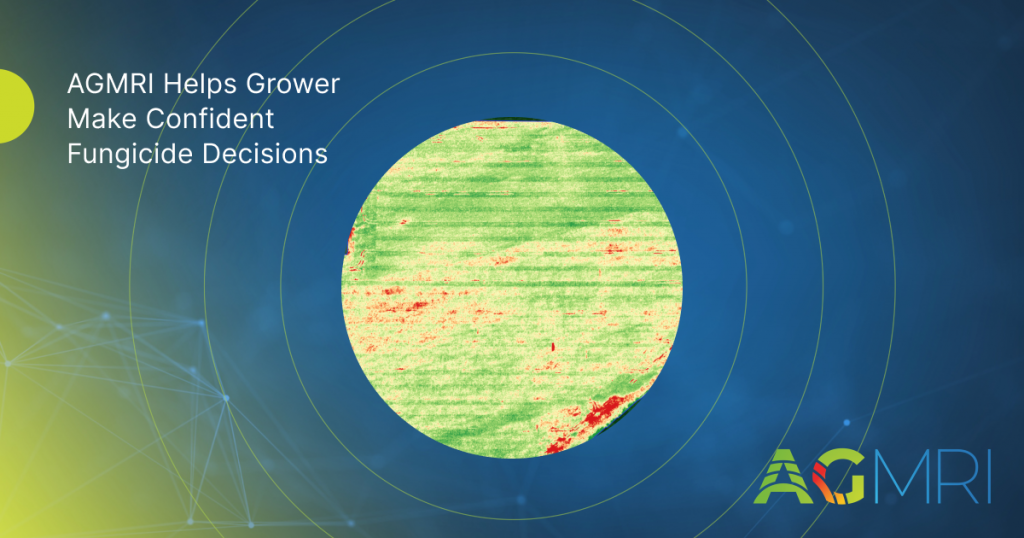
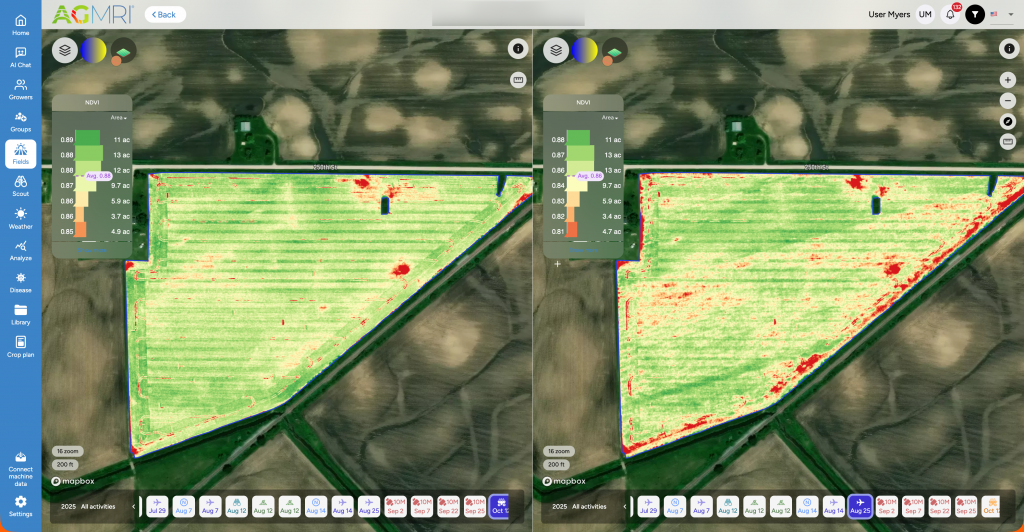
As the season progressed into later growth stages, he began weighing the economics of fungicide applications. With commodity prices fluctuating, the key question was whether making two passes of fungicide would pay off. By analyzing AGMRI’s nutrient deficiency and disease pressure layers in combination with crop stage data, the grower was able to narrow down the decision to a single field out of his six. That field showed a confident probability of delivering a positive ROI with a second fungicide pass.
Challenge
The grower was uncertain whether a second fungicide application would generate a return given current market conditions. Making multiple passes across all fields would be costly and time-intensive, with no guarantee of payoff. Without clear data, the risk of overspending on inputs or missing a yield-limiting disease outbreak weighed heavily on his decision.
AGMRI offered a way to evaluate both disease pressure and nutrient health across fields, providing an evidence-based approach to prioritize only those fields most likely to benefit.
Solution
AGMRI’s database and mapping capabilities gave the grower the insights needed to answer his critical question. By reviewing nutrient deficiency imagery alongside disease pressure maps, he identified that only one field was likely to deliver a positive ROI with a second fungicide application.
Rather than taking a blanket approach across all six fields, AGMRI helped him focus on where the payoff was most probable. This data-driven decision provided both confidence and efficiency in planning late-season management.
Results
Though harvest data is still pending, early indications suggest the decision will pay off. The grower expects a yield increase of 6–12 bu/ac on the field receiving a second fungicide application. Beyond potential yield gains, this experience has reinforced his trust in using AGMRI to make smarter, field-specific decisions that reduce risk and maximize ROI.