
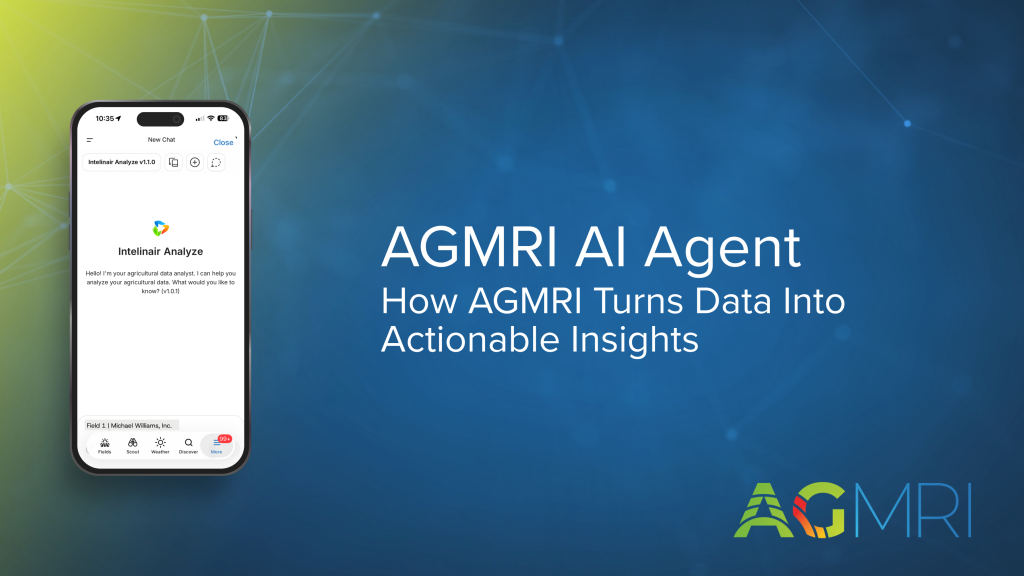

The AI Agent built by Intelinair is a purpose-built agriculture LLM for agriculture embedded in AGMRI. It helps agronomists and growers analyze field data, improve in-season management decisions, and evaluate field-level profitability using natural language.
What Is an Agriculture LLM?
An agriculture LLM (large language model) is an AI system trained specifically on agronomic data, crop performance, and farm management practices.
Unlike general-purpose AI tools, the AGMRI AI Agent is designed to understand:
- Crop growth stages and stress signals
- Field variability and yield drivers
- Weather and environmental impacts
- Management decisions and their outcomes
This allows it to deliver insights that are relevant, contextual, and practical for real-world agriculture.
How the Intelinair LLM Works Within AGMRI
The AGMRI LLM connects directly to data layers, allowing users to analyze and interpret:
- Satellite and aerial imagery
- Weather and environmental conditions
- Field activity and management records
- Historical yield and performance data
By combining these sources, the model can generate insights, reports for grower meetings, interactive dashboards, and field-level comparisons and recommendations
Key Benefits of Using AI in Agriculture
Faster Agronomic Decision-Making
Reduce the time between observation and action, especially during critical in-season windows.
Improved Field-Level Insights
Understand what is happening in each field, and why. The AI Agent draws on a deep base of agricultural intelligence to provide relevant and practical insights.
Scalable Expertise Across Teams
Enable agronomists and advisors to support more acres by simplifying data interpretation.
Agriculture AI Use Cases in AGMRI
Hybrid Performance and Placement Strategy
Evaluate how different hybrids perform across soil types, regions, and management practices. Use these insights to refine hybrid placement and improve outcomes in future seasons.
In-Season Crop Management Decisions
Analyze current crop conditions alongside historical trends and weather patterns to guide timely decisions during the growing season.
Field-Level Profitability Analysis
Assess performance beyond yield by incorporating input costs such as seed, fertility, chemical applications, and operational expenses. Identify opportunities to improve margins across fields and hybrids.
Why General AI Tools Don’t Work for Agriculture
Most AI models are trained on broad internet data, which lacks the specificity required for agronomic decision-making.
Agriculture requires:
- Localized field-level context
- Seasonality and timing awareness
- Understanding of inputs, practices, and outcomes
The LLM is built specifically for these challenges, making it more reliable for agricultural use.
Example Questions You Can Ask the AI Agent
The AI Agent developed by Intelinair supports natural language interaction, allowing users to ask questions such as:
- What factors are driving variability in this field?
- Which hybrids have performed best in this region over the past three seasons?
- Where should scouting efforts be prioritized this week?
- How did input decisions impact yield and profitability last season?
These types of queries help users quickly move from data to decisions.
The Future of AI in Precision Agriculture
As agriculture continues to generate more data, the ability to interpret and act on that data becomes increasingly important.
AI models like the AGMRI AI Agent represent the next step in precision agriculture, helping teams:
- Make faster, more informed decisions
- Improve operational efficiency
- Drive better outcomes across every acre
Bringing Intelligence to Every Acre with AGMRI
The AI Agent enhances the AGMRI platform by adding a layer of intelligence that simplifies complex data and supports better decision-making at scale.
For agronomists, retailers, and farm operators, it provides a more efficient way to understand performance, respond to in-season conditions, and plan for the future.