

By: Demitrius Kikalos, Sales Leader for Intelinair
By the time stress is visible from the road, the yield hit is already underway. I see it every season: whether the underlying issue is nitrogen deficiency, disease pressure, drought, or pest damage, the problem typically starts days, sometimes weeks, before any symptoms show up to the naked eye. The growers and agronomists I work with who consistently protect yield are the ones who close that gap, catching stress in its earliest stages while there’s still time to act.
This season, that gap matters more than usual. A lot of fields had cold-day exposure right after planting, and once you stack four or more days under 40 degrees on top of wet conditions, you’ve got a real risk for early-onset disease like crown rot. The clock starts ticking before most of us ever step into the field.
Here’s how I think about detecting crop stress early in a modern operation, from time-tested scouting to AI-powered field intelligence, plus the in-season move I’d recommend to protect what you’ve already got in the ground.
Why Early Detection Matters
Crop stress is rarely a one-time event. A wet spot in early June can turn into a nitrogen-loss problem in July and a yield drag at harvest. A disease that shows up in one corner of a field can move across acres in a matter of days under the right weather. Each day a problem goes unnoticed:
- The intervention window gets smaller
- Treatment options become more expensive (or stop working entirely)
- Yield potential quietly erodes
This year especially, early detection isn’t optional. Cold-and-wet conditions early on can drive crown rot, which on its own can cost up to 100 bushels per acre. And it leaves the plant far more vulnerable when tar spot and the other late-season diseases arrive. Mix crown rot and tar spot together, and that’s a perfect storm — the only way to stay ahead of it is to see what’s developing before it shows up at canopy level.
1. Strategic, Prioritized Scouting
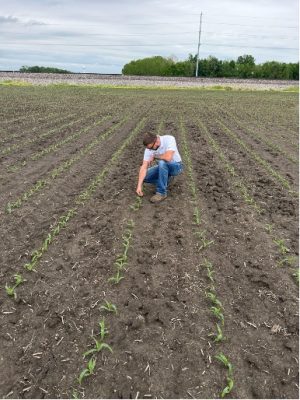
Boots-on-the-ground scouting is still the most reliable way to confirm what’s actually happening in a field. The challenge isn’t whether to scout. It’s where and when. A grower can easily span thousands of acres across multiple counties, and no agronomist I know can walk every acre every week.
The best growers I work with don’t try to scout everything equally. They use imagery and alerts to direct their attention to the areas most likely to be in trouble, then ground-truth from there. Scouting smarter, not harder, is the foundation of early detection at scale.
2. High-Resolution Aerial and Satellite Imagery
Vegetation indices like NDVI surface differences in plant vigor that the human eye can’t pick up from a pickup window. Aerial and satellite imagery captured throughout the season can flag underperforming areas long before stress shows up at the field level.
What matters is frequency and resolution. Low-resolution, infrequent imagery will miss developing issues. High-resolution imagery captured at multiple points across the season — especially during critical growth stages like V6, tasseling, and pod fill — gives you a clear, evolving picture of crop health.
3. Thermal Imagery for Invisible Stress
When a plant starts to stress, one of the first things it does is close its stomata to conserve water. That causes leaf temperatures to rise — often before any color change, wilting, or lesion is visible. Thermal imagery can detect elevated heat signatures and surface them as early warnings.
I lean on AGMRI’s thermal imagery for this exact reason. It flags areas of the field showing signs of stress before the symptoms become obvious in standard imagery — and that’s where you catch issues in the “invisible” stage.
4. Weather-Driven Disease Risk Modeling
A lot of the most damaging row-crop diseases — tar spot, gray leaf spot, southern rust, frogeye leaf spot, white mold, and others — develop under specific environmental conditions. By tracking temperature, humidity, leaf wetness, and other variables throughout the season, predictive models can estimate when disease pressure is building, often before any lesions are visible in the canopy.
The same logic applies earlier in the year. Stacked cold days after planting are themselves a leading indicator, telling you crown rot risk is climbing before you ever see a symptom. And because crown rot weakens the crop heading into the tar spot window, watching early-season weather is really watching late-season disease pressure too.
AGMRI monitors and accumulates risk for six major corn and soybean diseases throughout the season, which helps me recognize when pressure is climbing and when a fungicide application or targeted scouting trip is going to pay off.
5. Historical Zone-Based Performance Baselines
Every field has its own personality. Some zones consistently outperform; others always lag. Without that historical context, a “low” NDVI reading is just a number that could mean there is a real problem, or it could just be a low-producing area doing what it always does.
AGMRI builds five performance zones for every field based on the historical average of those zones, then compares the current season against that baseline. Underperforming Area alerts flag the spots that are falling short of their potential — which is exactly where intervention will have the biggest payoff.
6. AI-Powered Alerts
Even with great imagery and great models, the real bottleneck for most of us is attention. Nobody has time to study every field every week. That’s where automated alerts change the equation. Instead of asking you to look for problems, the platform finds them and pushes them to your phone.
AGMRI’s Alerts come in as push notifications when crop stress, emergence issues, weeds, disease risk, or underperforming areas show up at the zone or field level — so the next decision of the day is always the one with the highest return on attention.
Considerations for a V5 Fungicide Pass
Detection is half the equation. The other half is acting on what you see. With this season’s cold, wet start, a V5 fungicide pass might be a good idea to protect the investment you already have in the ground. In a typical year, a V5 fungicide adds about 5–15 bushels per acre. Pair it with a foliar feed in the same pass, and we routinely see 15+ bushels per acre on top of that.
A few practical notes from my experience:
- Timing: V5 to V8 works, depending on your other field operations. If you can condense passes across the field, that’s ideal.
- Pair it up: A V5 fungicide plus foliar feed in a single application is one of the most efficient in-season moves I’ve seen.
- The real risk: With input costs where they are, the risk this year is just breaking even. In my opinion, this is the season to protect what you have — not the season to skip protective passes and hope for the best.
Stack early-season cold-day exposure with conditions that drive crown rot, and the downside is severe; 100-bushel losses are on the table, and the crop heads into the back half of the season already compromised. A V5 fungicide doesn’t make those conditions go away. It just keeps them from compounding.
Putting It All Together
No single method catches every stress event. The approach I take with growers layers them: continuous imagery to see what’s happening, thermal data to catch what’s invisible, weather-driven models to anticipate disease, historical baselines to know what “normal” looks like for each acre, and AI-driven alerts to make sure nothing slips through. Then you act — with timely passes, like a V5 fungicide and foliar feed, when conditions justify them.
That’s the approach AGMRI is built around, which is why I trust it. By combining high-resolution aerial, satellite, and drone imagery with thermal analytics, weather-driven disease modeling, and historical zone performance, and surfacing all of it as actionable alerts, AGMRI helps growers and agronomists see issues before they become problems and act while there’s still time to protect yield potential.
Get Ahead of Crop Stress This Season
Early detection isn’t about scouting harder. It’s about scouting more efficiently, letting imagery, data, and AI direct your attention to the acres that need it most — and then making the in-season moves that protect what you’ve already invested.
If you want to see how AGMRI can help your operation catch crop stress earlier this season, reach out. I’d be happy to talk through it.